Arctic Arrival: Fear, Solitude, and Connection at the Edge of the World
On the first night of a solo ride from Alaska to Patagonia, a storm, a stranger, and a shared understanding changed everything.
"Everything is bigger in Texas."
Whoever said that had never been to Alaska. They had never seen wilderness that limitlessly unfolds in every direction — even at 30,000 feet.
I remember flying onto the glaciated base of Denali — the tallest mountain in North America — over twelve years prior. I was just a boy then, lost in a new world: the U.S. Navy. As part of a group training expedition, we were a pack of excited, doe-eyed midshipmen attempting to summit the icy peak. Even then, surrounded by equally clueless peers and knowledgeable guides, a deeper aloneness set in. Not socially, mentally, or even emotionally — though that, too, crept in at times. I mean on the most fundamental level: If something goes wrong, it's on you.
That first visit to Denali was a chance to feel what it meant to be "out there." To learn how quickly things can shift. How vital it is to stay composed when they do.
So it was familiar, that feeling washing over me again — this time on a flight north to the edge of Alaska's Arctic tundra. I was crammed between burly, bearded oil field workers on their way to a three-week shift. Only this time, I wasn't nineteen. I wasn't on a team. And I wasn't flying in to climb a mountain. I was beginning a solo ride — the length of the Americas. And unlike last time, I was now working with a prosthetic leg.
And for the first time, the excitement had tipped into something closer to fear.
Do I have enough food? Is my leg ready? What if I get an infection? What if the water sources aren't as plentiful as I thought?
But above all those unknowns loomed the only certainty I'd learned to expect from any undertaking like this — from Denali, to the Pacific Crest Trail, to the long road ahead: Things are about to get very uncomfortable.
So I was unsurprised by the swarms of mosquitoes that followed me even as I biked down the gravel road whose only purpose was to connect the oil pipeline to civilization. I was unsurprised by how hot the sun felt, even in the Arctic — forever circling overhead, offering only a brief, halfhearted submission to the horizon at 2 a.m. And I was unsurprised, that first night on the tundra, when a thunder and lightning storm rolled in just after I'd made camp.
The rain came hard. The rocky platform where I had pitched my tent turned quickly to a shallow pond. I sat inside, hand pressed to the frame overhead, worried it might collapse under the wind. I weighed my options — although I knew there were none.
Eventually, the storm passed as abruptly as it arrived. The sun — still high at nearly 10 p.m. — pierced the thinning clouds. And with it came a low rumble from the south.
A truck, as massive as all the others (though rare), slowed and pulled over. From the cab climbed a man whose frame made even the truck seem small. He stepped down the ladder and started walking toward me, a salty, muddy ballcap shading his eyes, beard full and red. I couldn't help but feel a little nervous. He looked like someone born of another species — the human manifestation of the tundra itself. But as he approached, the image softened. He looked like Santa Claus' nephew.
"Hey there!"
It felt like he didn't really have much he wanted to say — just a courtesy. Two humans acknowledging each other at the edge of the world. We exchanged a few basic words, but I was still buzzing from the rush of it all: the storm, the road, the silence.
And then I noticed it: his arm. Just as I noticed his prosthetic, he noticed my leg. Now we had something to talk about.
We swapped stories — motorcycle accident, infection. Hunting trip, gun backfire. He had been a hunting guide. Now he was an ice road trucker — one of those guys from the old TV show. He loved the cold. And he was curious. What's worse, losing an arm or a leg?
We laughed. Compared notes. Debated the small, annoying details only another amputee would appreciate: hopping to the bathroom in the middle of the night; cutting steak; wearing through the heel of your shoe… or the sleeve of your coat.
He introduced himself as Captain Hook. And somehow, it fit.
We didn't solve anything. But in the farthest reach of the continent, I found someone who, for those ten minutes, understood me better than anyone else in the world. He finished his gas-station dinner, washed his big ol' beard in the glacial stream beside my tent, and donated a collapsible fishing rod — along with some surprisingly good intel on grayling spots in the Brooks Range.
And just like that, he was gone — as suddenly as the storm.
Under a midnight sun, I laid out my gear to dry on the rocks, some of them streaked with fossilized trilobites — remnants of something far older than either of us. The place felt untouched. Clean in a way I hadn't known before.
It's strange how much can happen in a single night. There was fear. Awe. A storm. A stranger. Two amputees trading stories beside a glacial stream. And then, silence again.
Captain Hook rumbled north. I watched the dust settle behind his truck until it disappeared, then turned back to my tent — the fabric still wet, the air still sharp, the road ahead still endless.
But something had shifted. The fishing rod he left me leaned against a rock, catching the low sun like a trail marker.
Adventure often starts with the fear of the unknown—the "What if my gear fails?" or "What if I'm not strong enough?" But as I've learned from the Arctic to the gym, true performance isn't about the absence of fear or discomfort. It's about finding the "Captain Hooks" along the way—the moments of connection and the simple, practical adjustments that keep you moving. Whether you're training for a Paralympic dream or your first 5k, the goal is the same: stay composed when the storm rolls in, and keep an eye out for the trail markers. If you're preparing for an expedition of your own, the [Misogi Program](/programs/misogi) is built around exactly this kind of readiness.
About the Author
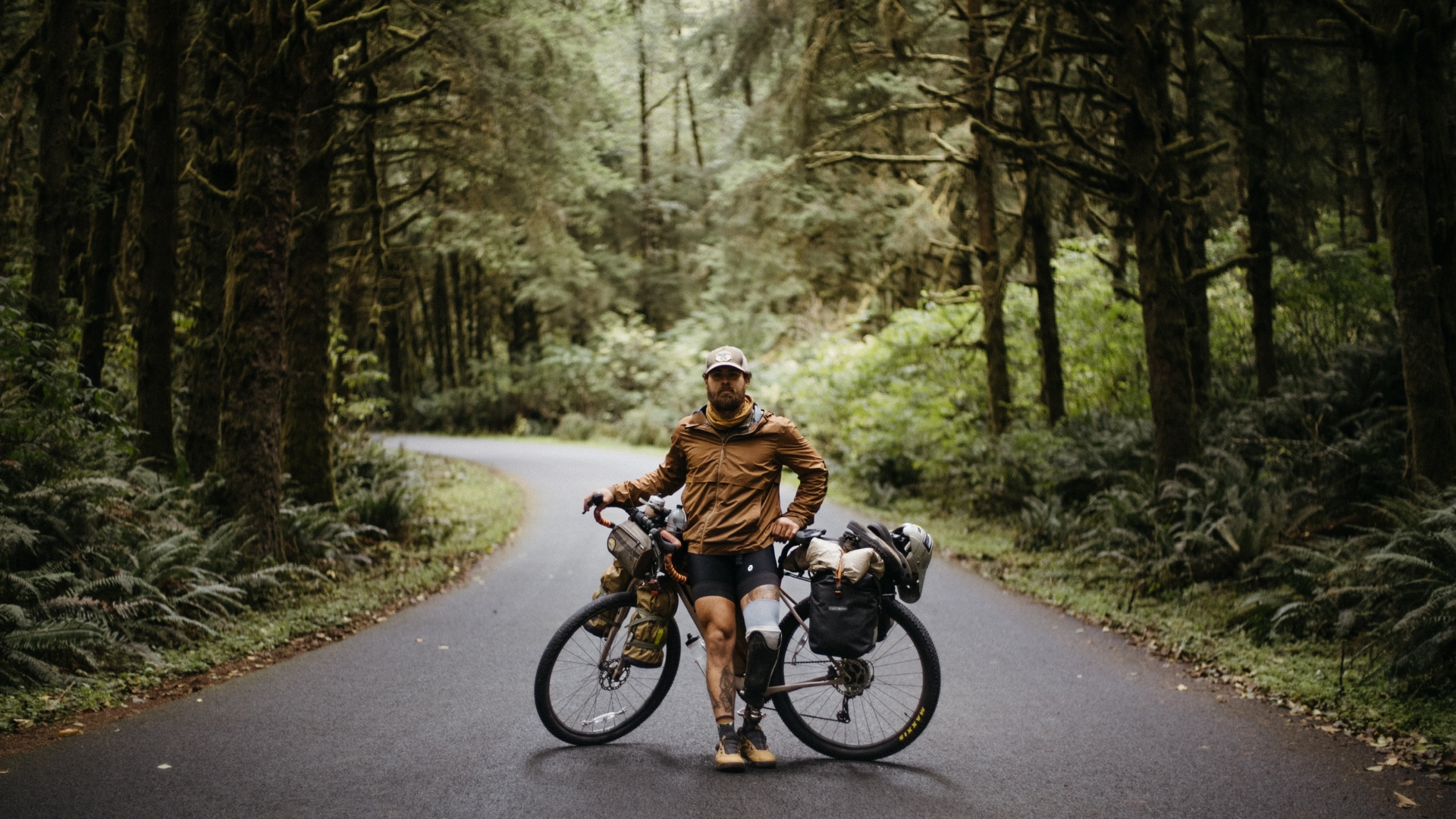
Sam Maddaus
U.S. Navy veteran, below-knee amputee, Certified Strength Coach, and Wilderness First Responder. Sam has thru-hiked the 2,650-mile Pacific Crest Trail, solo bikepacked 16,000 miles from Alaska to Argentina, and provided prosthetic care in Guatemala. He coaches from lived experience—building programs rooted in structural integrity, intentional movement, and mission-ready preparation.